UKAS Accredited Load Cell & Force Calibration Laboratory
Avery Weigh-Tronix operates a UKAS-accredited force calibration laboratory at its Head Office in Smethwick, West Midlands. We provide high-accuracy load cell calibration and force proving device verification for customers across the UK and internationally
Our laboratory is accredited by the United Kingdom Accreditation Service (UKAS) to ISO/IEC 17025, ensuring full traceability, technical competence, and internationally recognised certification.
Calibration & Environmental Evaluation
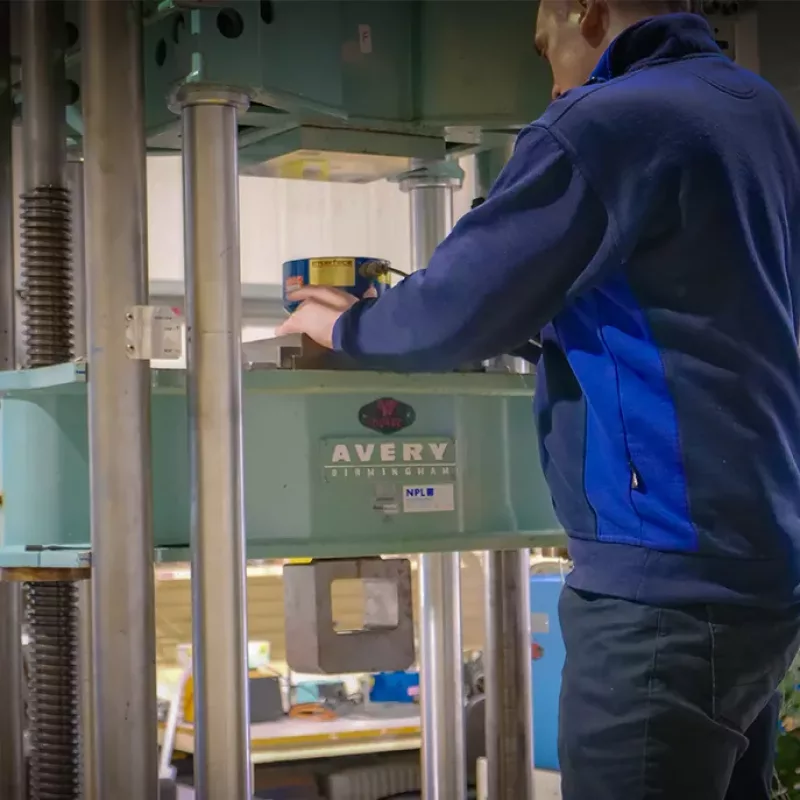
The laboratory is equipped with two primary deadweight force standardising machines with capacities of up to 500 kN (50 tonnes) or 11 kN (1.1 tonnes). These systems provide highly stable, low-uncertainty force generation across a wide operating range.
They are used primarily for the calibration of strain-gauged load cells and force-proving devices in accordance with: BS EN ISO 376, ASTM E74, UKAS-accredited in-house procedures
Calibration is tailored to your specific requirements, including device capacity, loading mode (tension and/or compression), and the applicable standard or accuracy class. Both machines can be fitted with temperature chambers operating from –10 °C to +40 °C, enabling performance evaluation under controlled environmental conditions.
This capability allows the laboratory to conduct UKAS-accredited testing in accordance with OIML R60.
Avery Weigh-Tronix's Force Laboratory
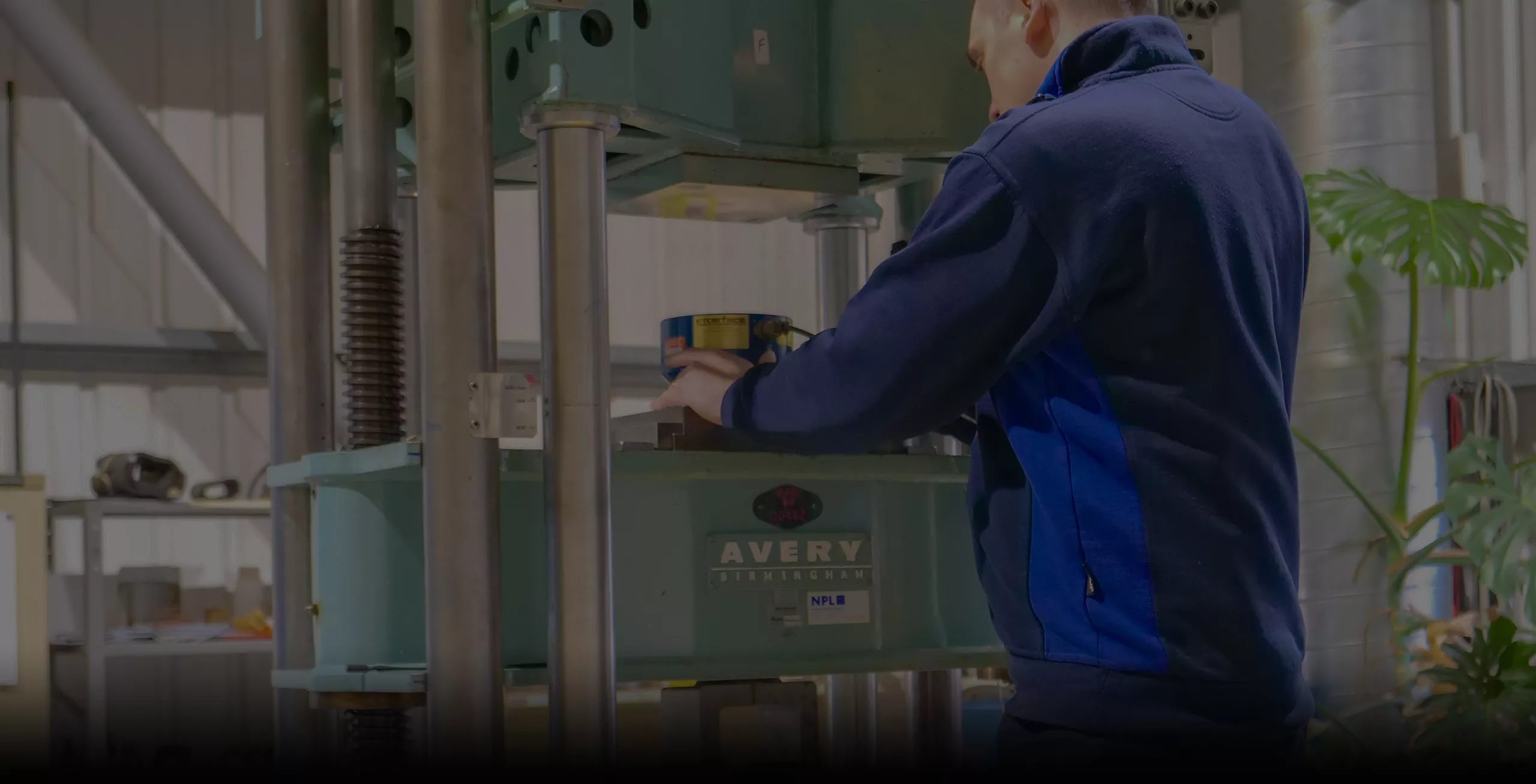
Avery Weigh-Tronix operates a high capacity (500 kN – 50 tonnes) deadweight force standardising machine at its Head Office in Smethwick, West Midlands. This machine and a smaller machine of 11 kN – 1.1 tonne capacity are the major instruments in the company’s force laboratory. This lab is accredited by the United Kingdom Accreditation Service (UKAS) to ISO/IEC17025.
The deadweight machines may be used for the testing of strain gauged load cells. They can also be used for other force proving and measuring instruments, including Digital Force Transducers.
The machines are equipped with a temperature chamber to allow the evaluation of a device’s performance. It covers a wide range of temperatures from -10 °C to +40 °C. This allows the laboratory to carry out UKAS accredited tests to the international OIML R60 standard.
Load Cell and Proving Device calibration
The deadweight machines may be used for the calibration of load cells and proving devices. This is done to BS EN ISO 376, ASTM E74 and accredited in-house procedures.
The laboratory offers a competitive UKAS accredited calibration service in accordance with its UKAS Schedule. Costs depend on the capacity of the device to be calibrated, the mode of calibration and the calibration standard required. They are available on application direct to the laboratory.

How does our specialist deadweight force standardising machine work?
In order to achieve the high accuracy of loading necessary for calibrating Weights and Measures approved load cells, there can be no substitute for a machine using pure deadweight to generate the test forces; hydraulic force generation and lever amplification are inadequate for the highest accuracies.
The 500kN machine comprises of four independently operated weight stacks. Each of these has a number of identical weights suspended one from another by shackles. They can be sequentially deposited by hydraulic rams onto loading frames. In fact, these frames are connected to the main cross-head of the machine. Thus, they apply the selected load to the instrument to be calibrated or tested.
The 11kN machine comprises of two independently operated weight stacks. Each of these has a number of identical weights suspended one from another by shackles. These can be sequentially deposited by an electrical drive system onto loading frames which are connected to the main cross-head of the machine, thus applying the selected load to the instrument to be calibrated or tested.
The drive systems on both machines facilitate incremental and decremental loading and the hysteresis calibration and testing of load cells and proving devices.
The masses and other components (including crosshead and weight pans) which form the calibrated load have been adjusted against reference standards traceable to national and international standards. They are also adjusted to allow for the effects of air buoyancy and the local value of gravity to apply forces in lbf units.
Technical Assurance. Commercial Confidence.
Choosing Avery Weigh-Tronix means partnering with a laboratory that offers:
UKAS-accredited ISO/IEC 17025 calibration
High-capacity 500 kN primary force standards
Environmental performance testing capability
Full traceability to national measurement standards
Competitive turnaround times
Experienced metrology engineers>
Our focus is not only on technical excellence but also on delivering calibration services that support product compliance, audit readiness, and commercial confidence.